Quick answer
Tanoura is Egypt's colourful whirling dance, rooted in Sufi devotion and best seen at the al-Ghuri complex in Islamic Cairo, where a heritage troupe performs several evenings a week. Belly dance, or raqs sharqi, is Egypt's classical solo dance, seen on Nile dinner cruises, in five-star hotel nightclubs and at weddings. Both are worth seeing; knowing their background makes them far more than a tourist show.
What is tanoura dance?
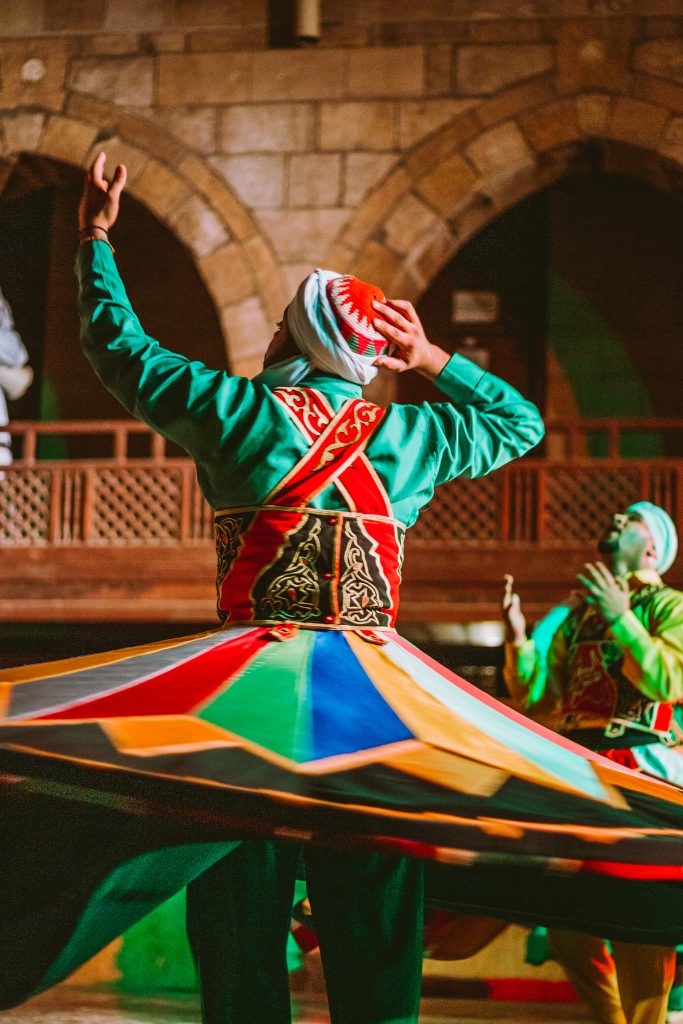
Tanoura is an Egyptian whirling dance in which a male dancer spins continuously, often for many minutes at a time, wearing heavy, multicoloured skirts that he lifts, splits and twirls above his head. The name comes from the skirt itself, the tanoura.
It grew out of the Sufi practice of turning as a form of devotion, the same tradition that produced the Mevlevi whirling dervishes of Turkey, but the Egyptian version is very different in feel. Where the Mevlevi ceremony is white, slow and meditative, tanoura is bright and theatrical, accompanied by drums, flutes and religious song (inshad) praising God and the Prophet. The spinning represents the movement of the planets and the soul's journey; the coloured panels are often said to represent the Sufi orders.
The best performers turn for very long stretches without visible dizziness, change direction, unfasten the outer skirts and hold them aloft like spinning wheels. It is a physical feat as much as an artistic one, and audiences of every age find it mesmerising.
Where can you see a tanoura show in Cairo?
The most respected tanoura performance in Egypt is staged by a state-supported heritage troupe in the al-Ghuri complex, the early 16th-century buildings of Sultan al-Ghuri on Al-Muizz Street, a few minutes' walk from Khan el-Khalili. The show is often listed as the Wikalet al-Ghouri tanoura, after the sultan's caravanserai, though the exact hall used within the complex has varied over the years.
- Schedule: at the time of writing, performances run on several evenings a week, typically starting around 7–8pm, but days and times change, so check locally or ask your guide before you plan your evening.
- Tickets: usually sold at the door shortly before the show, for cash. Seating is unreserved.
- Queues: arrive 45–60 minutes early in peak season (October to April) to get a good seat; the hall fills up.
- Length: about 90 minutes, including a musical opening and several tanoura dancers.
- Photos: usually allowed without flash.
The setting, a medieval stone hall in the heart of Islamic Cairo, is part of the experience. Combine it with a late-afternoon walk along Al-Muizz Street and dinner near Khan el-Khalili. Tanoura dancers also perform on Nile dinner cruises and at hotels, but those are shorter and part of a mixed floor show.
What is Egyptian belly dance?
Egyptian belly dance, known in Arabic as raqs sharqi (oriental dance), is a solo improvised dance of controlled hip, torso and arm movements performed to live Arabic music, and Egypt is widely regarded as its artistic home. Its modern stage form took shape in the Cairo nightclubs and films of the 1930s to 1950s, the golden age of Egyptian cinema, when dancers such as Samia Gamal and Tahia Carioca became national stars.
A good Egyptian performance is about musical interpretation rather than spectacle: the dancer responds to each instrument, from the drum (tabla) to the violin and oud, and the most admired performers are often subtle rather than acrobatic. A full show usually begins with an energetic entrance, moves through slower, emotional pieces and ends with a drum solo.
Its place in Egyptian society is complicated. Belly dance is loved at weddings and celebrations, where guests of all ages dance, yet professional dancing carries a social stigma in a conservative culture. In recent years many of the headline professional dancers in Cairo have been foreign. Understanding this helps you watch with more insight; for the music itself, see our guide to Egyptian music.
Where can you see belly dance in Egypt?
The most accessible place is a Nile dinner cruise in Cairo; the best professional performances are in the nightclubs of some five-star Cairo hotels, where top dancers perform late at night with a full orchestra.
- Nile dinner cruises: almost all include a belly dancer and a tanoura dancer as part of the evening. It is the easiest option and family-friendly, though the dancing is a short set rather than a full show. Our Nile dinner cruise guide explains how to choose a boat.
- Hotel nightclubs and supper clubs: several Cairo hotels have long hosted belly dance shows with live bands. Headline dancers often take the stage after 11pm or midnight, with a minimum spend or set dinner. Which venues host which dancers changes often, so ask locally.
- Red Sea and Luxor hotels: resort shows are usually short and aimed at entertainment rather than artistry.
- Weddings: the most authentic setting of all. If you see a wedding party (zaffa) in a hotel lobby with drummers and dancing, you are welcome to watch from a respectful distance.
How do you watch respectfully?
Treat both tanoura and belly dance as serious art forms: watch attentively, ask before filming close-up, and follow local cues on tipping and participation.
- Tanoura is religious in origin: although the al-Ghuri show is a stage performance, the songs are devotional. Applaud at the end of each section rather than mid-spin.
- Dress: smart-casual is fine for both; cover shoulders and knees for the al-Ghuri show, which is held in a historic Islamic building.
- Filming: phones held up throughout block the view for others. Take a few photos, then put it away.
- Joining in: belly dancers often invite guests to dance. It is good-humoured; join in or smile and decline.
- Tipping: at hotel shows and cruises, a discreet tip for the musicians or dancer is appreciated if they perform at your table. Throwing money over a dancer is a wedding custom, not something to copy in a hotel.
- Families and conservative travellers: belly dance costumes are revealing by Egyptian standards; if that is a concern, tanoura is a good choice for everyone.
What other traditional performances are worth seeing?
If you enjoy tanoura, look out for zar, Sufi dhikr at religious festivals, Nubian music in Aswan and performances at the Cairo Opera House.
- Zar: a traditional healing ritual with drumming and chant, historically led by women. A Cairo cultural centre near Saad Zaghloul's house has for years hosted weekly zar performances by the Mazaher ensemble; check that they are still running.
- Dhikr at moulids: at saints' festivals, Sufi brotherhoods perform the dhikr, rhythmic chanting and swaying that is the devotional root of tanoura. See our guide to moulids.
- Nubian music: in Aswan, Nubian bands play drums and the tar frame drum at village events, some restaurants and on dahabiyas.
- Cairo Opera House: hosts Arabic music concerts, ballet and folk dance; check the programme when you are in town.
For more ideas on how to spend evenings in the capital, see our guide to Cairo after dark.
Tanoura or belly dance: which should you see?
If you only have one evening, see the al-Ghuri tanoura show; add belly dance through a dinner cruise if you want a lighter, social night, or a late hotel show if you are serious about the art form.
- Families and first-timers: the al-Ghuri tanoura, followed by dinner near Khan el-Khalili. It starts early, suits all ages and costs little.
- Couples and groups after a fun night: a Nile dinner cruise, where you see both dances in a single evening with dinner and river views.
- Dance enthusiasts: a headline belly dancer with a full orchestra at a five-star hotel, accepting the late start and higher cost.
- Travellers interested in religion and music: tanoura plus a moulid or a zar performance, if your dates allow.
In Cairo the al-Ghuri show and a dinner cruise fit easily on different nights of a three or four-night stay.
Frequently asked questions
Is tanoura the same as whirling dervishes?
They share Sufi roots, but tanoura is an Egyptian folk form with colourful skirts, drums and song, while the Mevlevi whirling of Turkey is a slower, white-robed religious ceremony.
How much does the al-Ghuri tanoura show cost?
Tickets are inexpensive and sold at the door for cash, but prices change, so check locally. Arrive early, as seating is unreserved.
Is belly dance appropriate for children?
The dinner-cruise shows are family-friendly. Late-night hotel nightclub shows are aimed at adults and start too late for most children.
When do belly dancers perform in Cairo hotels?
Headline dancers usually perform late, often after 11pm or midnight. Ask the venue for the exact timing and minimum spend.
Can I see tanoura outside Cairo?
Yes. Tanoura dancers perform on Nile cruise ships, at resort hotels in Luxor and the Red Sea and at some restaurants, but the al-Ghuri troupe in Cairo is the most accomplished.